Articles
What we learn building tools for businesses, shared plainly.
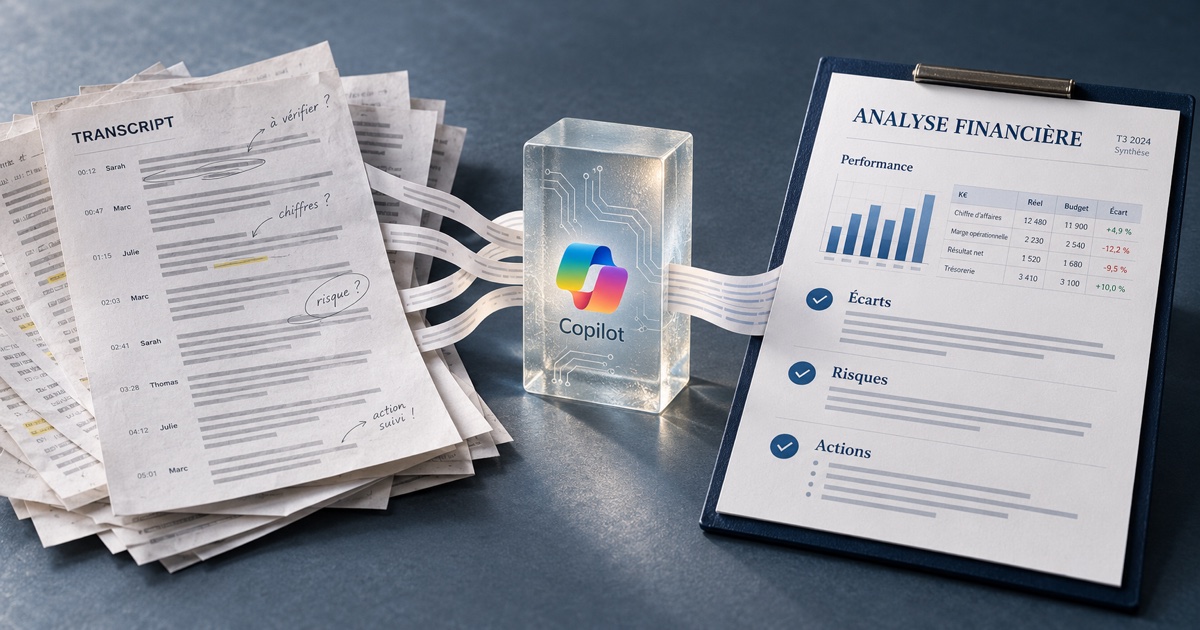
Copilot in finance: turning a transcript into an assistant that delivers exactly what you expect
You have the transcript of a meeting where leadership explains how they want to receive their analyses. Pasting it into Copilot as is gives you a generic result. The right approach: extract the rules from the transcript, encode them as triggers ("when I ask for X, produce Y") in a Copilot agent, then test before relying on it. Includes a complete example for month-end variance analysis.
I asked two AIs to describe me. Here's what they saw, and what they missed
I asked ChatGPT and Claude the same question: "If you had to describe me, how would you describe me?" Both portraits had some accurate observations, a lot of flattery and the same flaw, named bluntly. The exercise says as much about these tools as it does about me.
Saying "thank you" to ChatGPT: Is it really wasteful?
For your business, the real savings come mostly from which tasks you hand off to AI and how you automate them.
Your Next Software Might Just Be an Excel File
AI is making apps faster and cheaper to build. But before you build anything, you need to understand the problem. For a small business, a shared spreadsheet, a form or an automation is sometimes all it takes. The real work is choosing a tool that fits the need — and recognizing when custom software is worth it.
Code Costs Nothing Now. Everything Else Costs More
AI has made writing code almost free, but it isn't speeding up projects as much as we'd hoped, because coding was never the real bottleneck. According to Amdahl's law, if writing code makes up 25% of the cycle, making it instantaneous gives you a 1.33x gain at best. And as Jevons observed with coal, whatever gets cheaper gets used more: we're producing more code, which means more code to read, check and maintain.