
AI · Development in the age of AI
Code Costs Nothing Now. Everything Else Costs More
AI has made writing code almost free, but it isn't speeding up projects as much as we'd hoped, because coding was never the real bottleneck. According to Amdahl's law, if writing code makes up 25% of the cycle, making it instantaneous gives you a 1.33x gain at best. And as Jevons observed with coal, whatever gets cheaper gets used more: we're producing more code, which means more code to read, check and maintain.
DexavisionOctober 6, 20265 min read

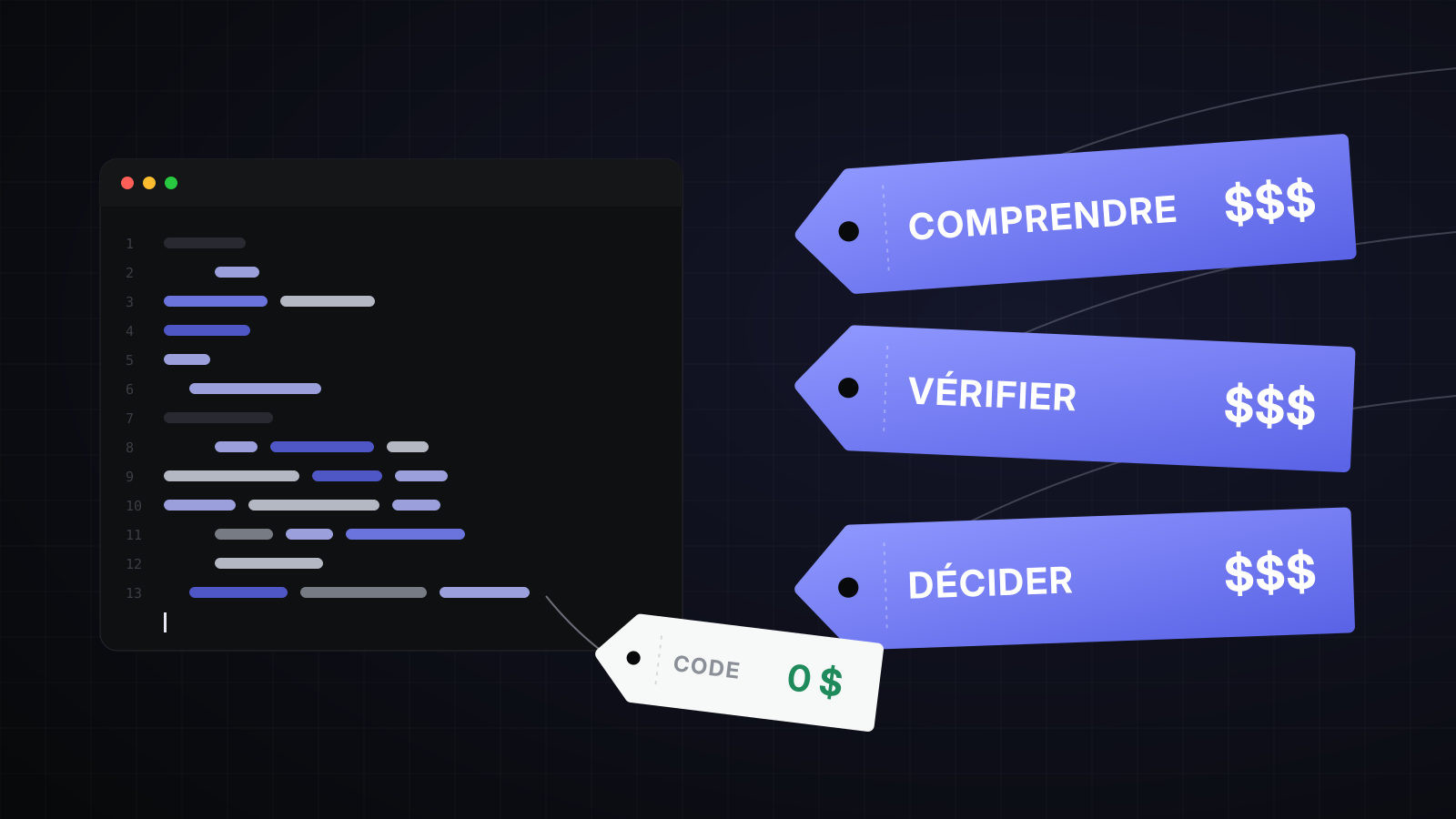
Code Costs Nothing Now. Everything Else Costs More.
AI has made writing code almost free. Bad news: that was never the problem.
For fifty years, our industry chased the same thing: writing code faster. Better languages, better frameworks, better IDEs, autocomplete, then assistants, then agents that open their own pull requests while we sleep.
We got there. Producing a thousand lines of working code now takes about as long as writing a clear request.
And yet projects aren't shipping ten times faster. Backlogs haven't emptied. Teams aren't sitting idle. There's a reason for that, and it's more interesting than "AI isn't good enough yet."
1.33x, at best.
Amdahl's Law Applies to Humans Too
Everyone in computing knows Amdahl's law: the gain you get from speeding up part of a system is limited by the share of time that part actually takes up.
Let's try it with a development team. Say writing code accounts for 25% of the time between an idea and its release to production. The rest is understanding the need, resolving ambiguities, reviewing, testing, deploying, fixing and persuading people.
Now make writing code infinitely fast. What's the maximum gain across the whole cycle?
accélération = 1 / (1 - 0,25) = 1,33x
A third faster. Not ten times. Not a hundred times. Even with a perfect tool.
Code was never the bottleneck. It was just the most visible part of the work, so it was the part we wanted to optimize.
Cheaper means more consumed.
Jevons Saw This Coming in 1865
The economist William Stanley Jevons noticed something counterintuitive about coal: the more efficient steam engines became, the more coal England burned. Making a resource cheaper to use doesn't reduce how much of it gets used. It opens the door to all the uses that weren't worth it before.
Replace "coal" with "code."
When writing software is expensive, you only write what's worth it. When it costs next to nothing, you write everything: the script you would have done by hand, the internal tool nobody would have funded, the third rewrite of a module "while we're at it."
The result: there isn't less work. There's a lot more code. And every line produced is still a line to read, understand, secure and maintain.
Generated code is free to write. You pay full price to read it.
Where the constraint has moved.
The Three New Bottlenecks
If writing isn't the constraint anymore, where has it gone?
1. Knowing what to ask for
An agent will faithfully carry out a vague request and deliver a vague result, but with confidence. The rare skill is no longer translating intent into syntax. It's having a precise intent to begin with: the edge cases, the constraints, the things you absolutely don't want.
Ironically, the specification, the document developers avoided for twenty years of agile, is once again the most important artifact in the project.
2. Checking what you get
Reading code has always been harder than writing it. We've just multiplied the volume to read without multiplying the number of readers.
The teams doing best aren't the ones generating the most. They're the ones that have invested in automated verification: solid tests, strict types, environments where the agent can see for itself that it got something wrong. Tests aren't a safety net anymore. They're the contract.
3. Saying no
When anything can be done in an afternoon, the question is no longer "Can we build it?" but "Should we?" Every feature you add is one more surface to support, document and explain to users.
Judgment, or taste if you prefer, can't be generated. And it's becoming the asset that separates a good product from one that's just full of stuff.
One piece of software, one need.
The Most Underrated Side Effect: Disposable Software
This is the part that fascinates me most.
Historically, software had to serve thousands of people to justify what it cost to develop. That equation just broke. You can now build an application for a single user, for a single problem, and throw it away once the problem goes away.
A custom tool for a twelve-person small business. An app for an event that lasts one weekend. A dashboard that answers a single question, once.
This changes the very nature of the job. We're moving from an industry that makes products to an industry that makes answers. And the whole market of needs too small to interest a software vendor, which is to say most real needs, has just opened up.
Then and now.
What This Means for Us
| Then | Now |
|---|---|
| Knowing how to write | Knowing how to read and judge |
| Knowing the syntax | Knowing the business domain |
| Producing volume | Reducing ambiguity |
| Tests validate the code | Tests define the code |
| Building for as many people as possible | Building for the exact need |
Developers who defined themselves by how fast they could type have a problem. Those who defined themselves by how well they understood the client's problem have just been handed enormous leverage.
What can't be generated.
Conclusion
AI hasn't replaced developers' work. It has taken away the mechanical part and left everything that was hard from the start: understanding, deciding, verifying.
We thought our value was in the code. It was in everything that happens before and after.
The good news is that this part can't be generated.